Tropical cyclones are among the most destructive natural disasters for farmers in developing countries. Yet farmers are not passive actors when disaster strikes. They can change how much land they cultivate, switch crops, invest in irrigation, adjust input use, or shift production across growing seasons. The question is whether these responses are enough to offset the damage.
In a recently published paper, How Do Indian Farmers Adjust After Cyclones? Evidence from 1959–2014, I studied how Indian farmers adjusted agricultural production following cyclones over nearly six decades. The Indian agricultural sector underwent a dramatic transformation between the late 1950s and 2014, as productivity increased, irrigation expanded, and production shifted toward higher-value crops. These changes created new opportunities for adaptation, but they also altered the constraints farmers faced.
Measuring cyclone exposure and agricultural adjustment
The analysis combines historical agricultural production data for 21 crops across 271 districts in 13 Indian states with event-specific meteorological information on the intensity and frequency of cyclones. Rather than relying on reported disaster damages, which can be biased, I construct the geographic “footprint” of each cyclone and measure the share of a district exposed to cyclone-force winds. Given the multiple growing seasons in India, the timing of each disaster event is matched with crop-by-district-level growing seasons to determine whether a shock occurred before or after the sowing season of a given crop.
I then estimate the impact of cyclone exposure, including its lagged effects, on agricultural production and find statistically significant declines in output, area planted, and calorie content. For an average cyclone exposure of about 60 percent of a district’s area, agricultural output declines by 7.3 percent over a five-year period. Area planted falls by 4.8 percent and the calorie content of agricultural production by 7.4 percent. These results highlight the sizeable economic costs associated with these large, rare weather shocks, especially in a context where insurance penetration is low.
However, these averages conceal important differences in how farmers’ responses to these shocks changed over the nearly six decades studied in this paper.
From expanding cultivation to withdrawing land
During the 1960s, farmers responded very differently. Following cyclone exposure, the area planted increased cumulatively by 23.5 percent (Figure 1). Farmers expanded agricultural production along the extensive margin, primarily by bringing marginal and previously barren land into cultivation. They also adjusted production across multiple growing seasons within the same agricultural year, allowing them to partially offset cyclone-related losses.
Importantly, this response was concentrated among farmers exposed to cyclones for the first time. Farmers in districts that were historically cyclone-prone did not expand cultivated area in the same way, suggesting that production decisions had already adjusted to the underlying risk.
Over time, however, this pattern has reversed. From the 1980s onward, cyclone exposure was associated with declining rather than expanding cultivated areas. For an average cyclone exposure, the cumulative reduction in area planted grew from 6.3 percent in the 1980s to 36 percent in the 1990s and 32.2 percent after 2000.
Figure 1. Cumulative effect of cyclone exposure on agricultural production, by decade
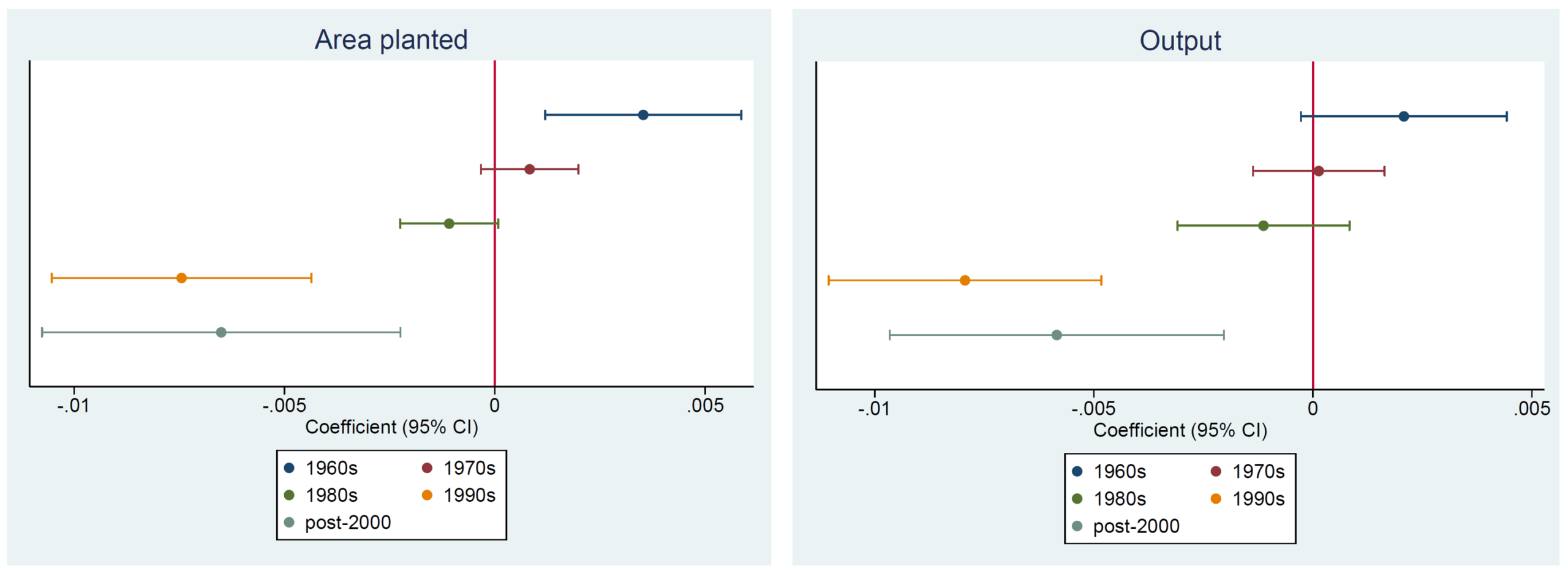
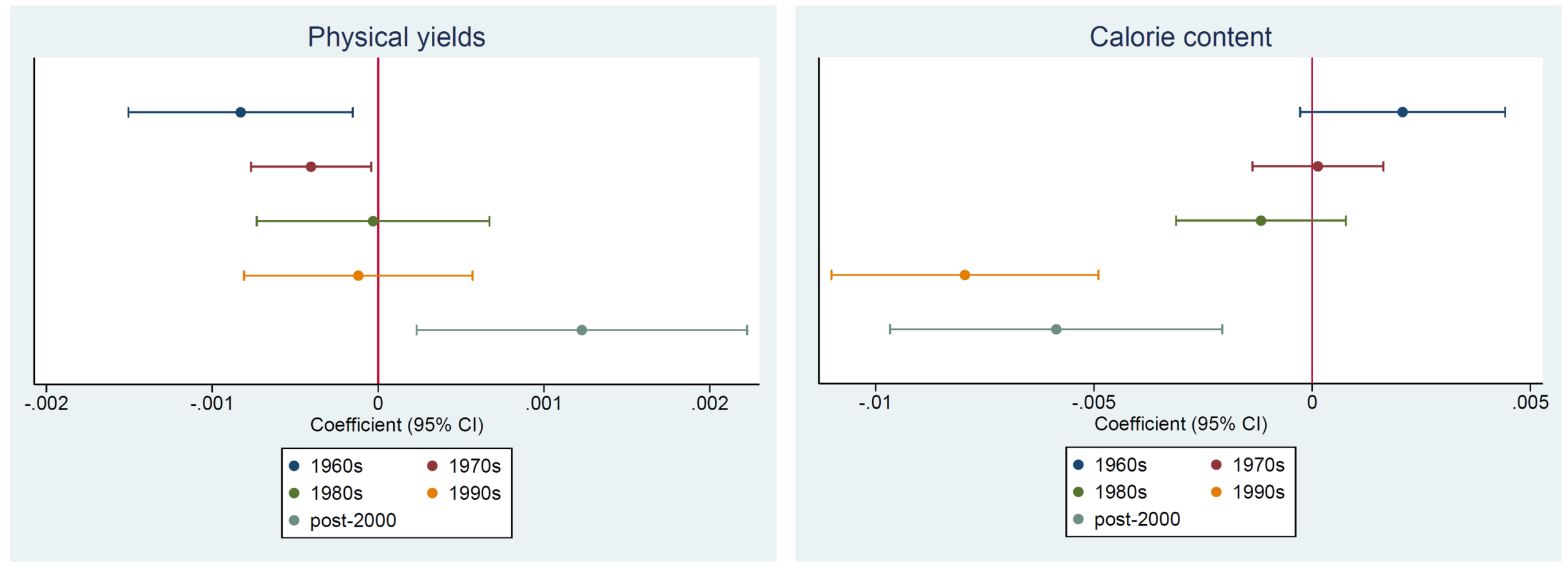
Note: Dots show the estimated cumulative effect of cyclone exposure on area planted, agricultural output, physical yields, and calorie for each period. Horizontal bars indicate 95% confidence intervals; the red vertical line marks zero. Negative (positive) coefficients indicate reductions (increases) in the respective agricultural outcome, while confidence intervals that cross zero are not statistically distinguishable from zero at the 5% level.
The results therefore suggest that farmers have become less able—or less willing—to maintain land under cultivation following cyclone shocks. While the data cannot identify the precise producer-level mechanism behind this contraction, the change is substantial: an adaptation strategy that partially offsets losses early in the sample period largely disappears in later decades.
Farmers still adapt—but adaptation is not enough
The disappearance of land expansion does not mean farmers stop adjusting. They change their crop mix following cyclone exposure, reducing production of high-calorie, relatively low-value crops such as coarse cereals and shifting toward higher-value food crops.
I also find significant expansion of irrigation following cyclone exposure (Figure 2). Both net and gross irrigated area increase, consistent with the broader expansion of irrigation systems that accompanied India’s agricultural transformation.
These responses matter, but they are not sufficient to offset the increasingly adverse effects of cyclones. In the 1990s and post-2000 period, both planted areas and output were declining substantially in the aftermath of cyclones despite crop diversification and irrigation investment.
The long-run effects are substantial. Over 20-year periods, areas with greater cyclone exposure experienced lower agricultural output, yields, and calorie production, even as net irrigated area increased. This suggests that farmers adapted in part through greater irrigation, but that these responses were not sufficient to offset the longer-run losses associated with cyclone exposure.
Figure 2. Cumulative effect of cyclone exposure on agricultural inputs, by decade
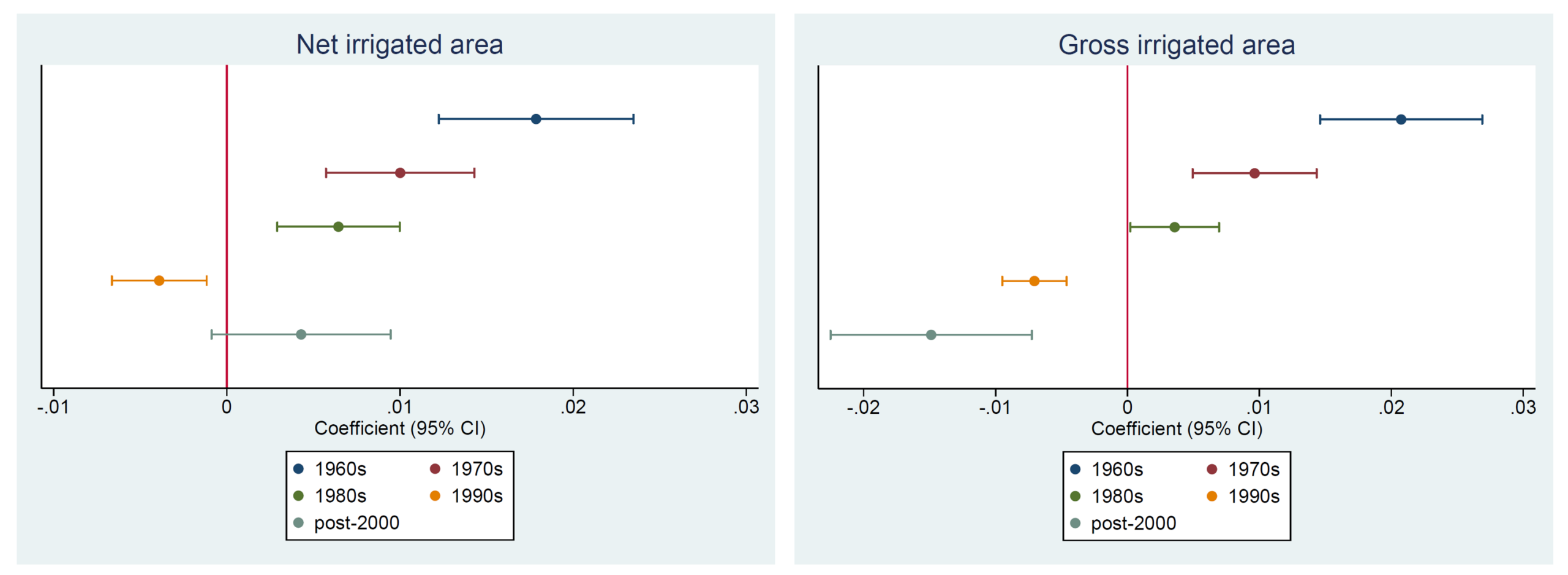
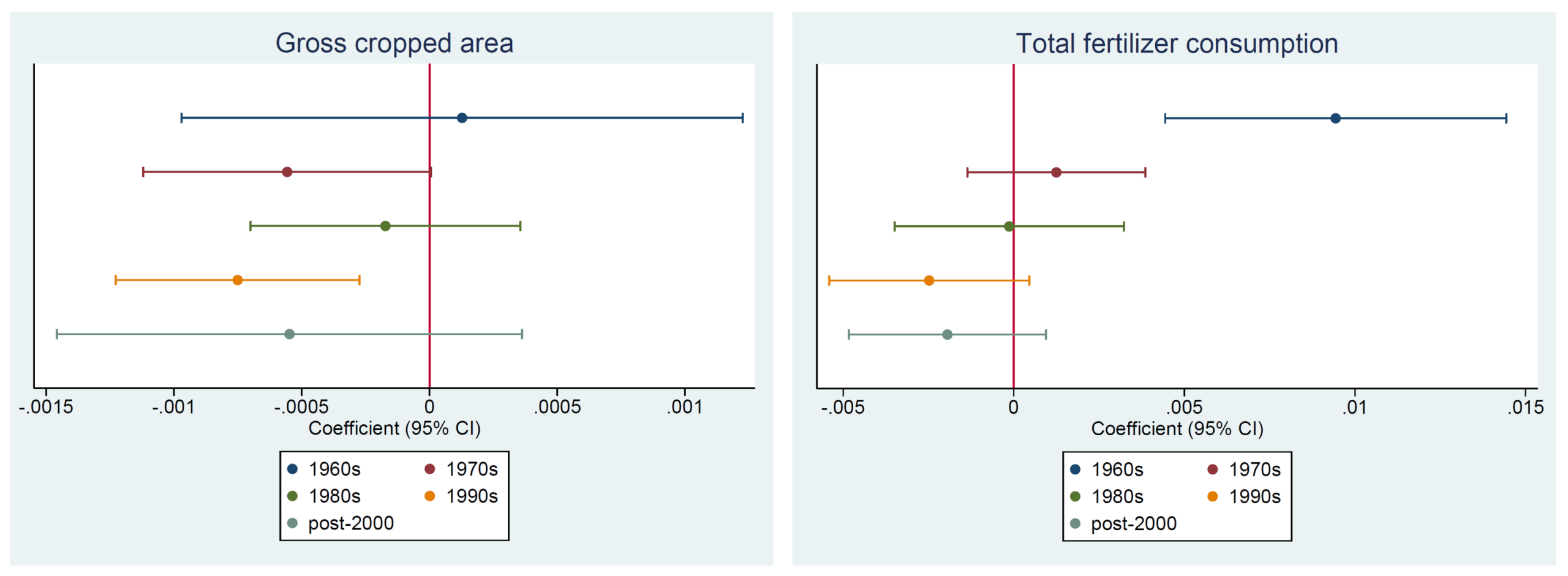
Note: Dots show the estimated cumulative effect of cyclone exposure on net and gross irrigated area, gross cropped area, and total fertilizer consumption for each period. Horizontal bars indicate 95% confidence intervals; the red vertical line marks zero. Negative (positive) coefficients indicate reductions (increases) in the respective agricultural input, while confidence intervals that cross zero are not statistically distinguishable from zero at the 5% level.
Assistance should extend beyond immediate disaster relief
These findings have implications for how post-disaster assistance is designed. Emergency support remains essential, but the effects of cyclones do not end once immediate reconstruction is complete. Losses persist in the medium and long term, while the adaptation options available to farmers appear increasingly unable to offset them.
Disaster recovery efforts should therefore go beyond short-term support measures and be followed by medium-term development programs focused on rebuilding sustainable livelihoods. This could include investments that strengthen farmers’ productive capacity, improve infrastructure, and expand access to insurance, credit, and other risk-mitigation mechanisms.
The broader lesson is that adaptation is not a fixed response. It changes as economies transform and as the opportunities and constraints facing households evolve. Understanding those changes is essential for designing policies that help farmers recover not only from the next cyclone, but also from the persistent economic effects that remain long after the storm has passed.