Since the turn of the new millennium, territorial disparities in real returns to labor have increased in many advanced and developing countries, influencing migration patterns and, in some cases, fueling political and social tensions. The gaps between rural and urban wages have grown in many developing countries, including China and many Central and Eastern European convergence economies where export-led growth powered growth in urban areas. This did not happen in most Latin American countries.
Using millions of observations from harmonized household surveys and censuses, we explore in a recent paper how real labor incomes and place productivity have evolved in various geographic locations – from dense cities to remote areas – within 14 Latin American countries since the early 2000s. We observe a striking convergence in real labor incomes and place productivity, at both state and municipal levels, reducing the rural-urban income divide in most countries during the 2000s and the 2010s. As a result, the historically large territorial differences narrowed. Income disparities between the largest cities and other areas also declined (Figure 1).
Figure 1. Average income gap with the leading area and its decomposition by country
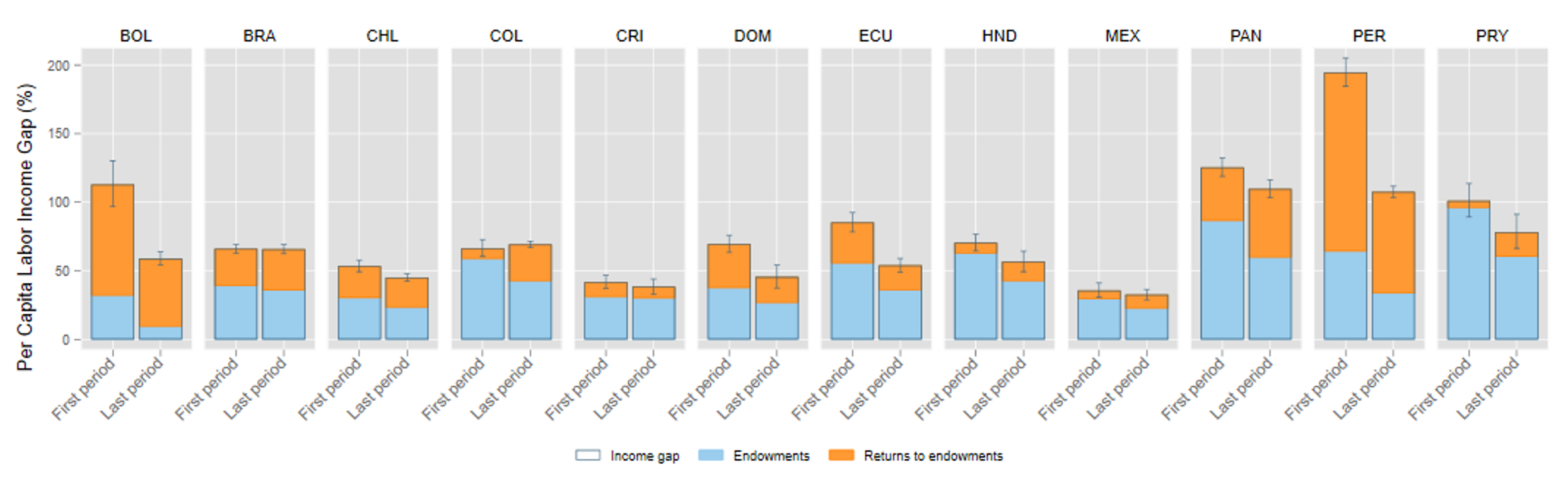
Note: The income gap is decomposed into an endowment component, capturing differences between the nongeographic household characteristics, such as education, demographics, and employment, in the leading metropolitan and other areas, and a returns-to-endowments component, capturing differences between the returns to these characteristics in the leading and other areas. The figure shows the 95% confidence interval. To ensure comparability within and across countries, the per capita household labor earnings are deflated to adjust incomes for cost-of-living differences across space and time. The leading metropolitan areas are the capital cities, except in Bolivia (BOL): Santa Cruz; Brazil (BRA): Belo Horizonte, Rio de Janeiro, and Sao Paulo; Costa Rica (CRI): urban Central Valley region (includes San Jose and other main cities); Ecuador (ECU): Quito (urban Pichincha); Panama (PAN): urban Panama Province. First period refers to the early 2000s; last period refers to the late 2010s; both periods vary by country.
These declines represent both good and bad news. The good news is that poorer, predominantly rural areas have been catching up with more affluent, predominantly urban municipalities reflecting improvements in agricultural productivity and investments in extractives during the commodity boom driven by strong demand from China. As growth in rural and smaller urban areas picked up, the income gaps with the leading Latin American cities lessened, reflecting improvements in household endowments, especially education. The bad news is that productivity growth in many urban areas, where most of the workforce is concentrated, was relatively weak due to high congestion costs and limited agglomeration benefits reflecting a shift toward low-productivity employment following the deindustrialization of LAC cities, poor connectivity, and urban divisions.
Yet, large income gaps with metropolitan areas continue to persist in most countries (Figure 1), mainly because more educated individuals tend to concentrate in larger cities. By contrast, among the poorest 40 percent of households, the gaps between the leading areas and other parts of these countries mostly reflect differences in the returns to endowments. These are small or have diminished, implying that by 2020 the potential returns to domestic migration to the largest cities had become relatively small for the bottom 40 percent of Latin Americans (Figure 2). With limited possibilities at home, some poor households increasingly looked abroad for possibilities to bolster their incomes.
Figure 2. Average income gap with the leading area for the poorest 40% by country
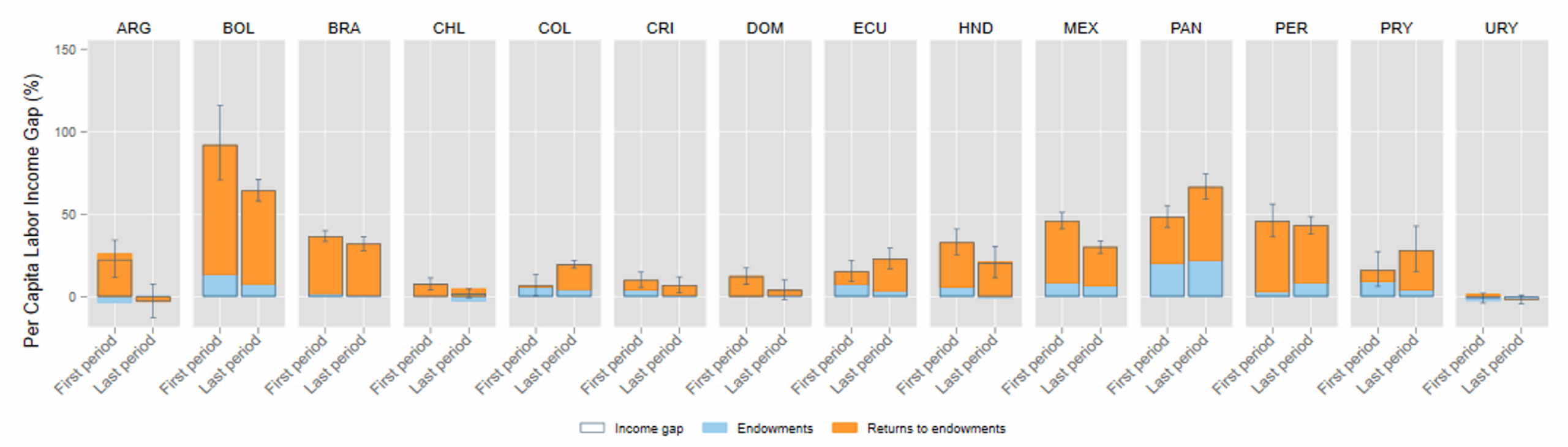
Note: The income gap is decomposed into an endowment component, capturing differences between the nongeographic household characteristics, such as education, demographics, and employment, in the leading metropolitan and other areas, and a returns-to-endowments component, capturing differences between the returns to these characteristics in the leading and other areas. The figure shows the 95% confidence interval. To ensure comparability within and across countries, the per capita household labor earnings are deflated to adjust incomes for cost-of-living differences across space and time. The leading metropolitan areas are the capital cities, except in Bolivia (BOL): Santa Cruz; Brazil (BRA): Belo Horizonte, Rio de Janeiro, and Sao Paulo; Costa Rica (CRI): urban Central Valley region (includes San Jose and other main cities); Ecuador (ECU): Quito (urban Pichincha); Panama (PAN): urban Panama Province. The results for Argentina and Uruguay reflect only differences between the bottom 40 percent of household located only in urban areas. First period refers to the early 2000s; last period refers to the late 2010s; both periods vary by country.
Only in Bolivia, Brazil, Panama, and Peru could the residents of the poorest subnational regions potentially become better off by migrating domestically to leading cities (Figure 3). In these countries, the variation in income gaps across states and provinces mostly reflects variation in the differences in returns to endowments, rather than variation in the level of endowments with the leading areas, indicating that the costs of migration tend to grow with distance. Some of these barriers can be reduced, for example, with investments in transport services and infrastructure and the provision of affordable quality housing for low-income residents in large cities. But other barriers may be more difficult to reduce as they may reflect location preferences.
Figure 3. Income gaps by administrative region in select Latin American countries
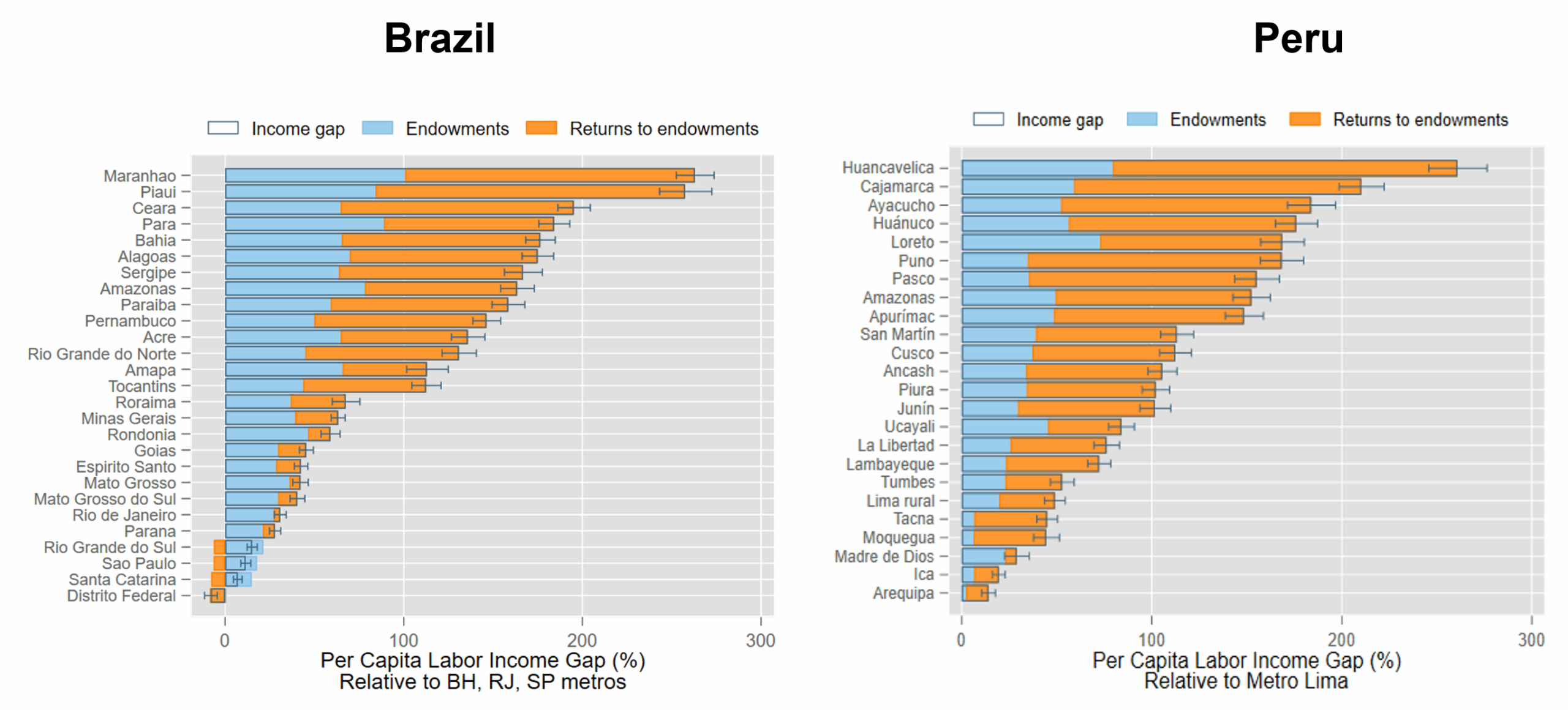
Note: The income gap is decomposed into an endowment component, capturing differences between the nongeographic household characteristics, such as education, demographics, and employment, in the leading metropolitan and other areas, and a returns-to-endowments component, capturing differences between the returns to these characteristics in the leading and other areas. The figure shows the 95% confidence interval. To ensure comparability within and across countries, the per capita household labor earnings are deflated to adjust incomes for cost-of-living differences across space and time. The leading metropolitan area in Brazil includes Belo Horizonte, Rio de Janeiro, and Sao Paulo and in Peru, it is Lima. Reported income gaps are from the latest period (late 2010s).
These findings suggest that Latin America’s resource-driven model of development delivered convergence in incomes and place productivity but was not successful at lifting nationwide incomes in a sustained way. Economic growth has remained weak because the leading cities, where most of Latin America’s workforce is concentrated, are struggling. To lift growth without increasing territorial income gaps, governments should implement a mix of horizontal and place-based policies.
Nationwide, governments must protect macroeconomic stability, invest equitably in quality education services , reduce regulatory hurdles, and improve institutional quality and intergovernmental fiscal systems. Making regulations simpler and more predictable, increasing the transparency of legal frameworks, strengthening competition policy, property protection, rule of law, and facilitating trade and investment will stimulate private investment and the growth of sectors producing urban tradables (e.g. manufacturing and tradable services). Place-based investments should aim to improve international and domestic connectivity infrastructure and services, which can generate substantial income and welfare gains. Improving intraurban connectivity, the provision of basic urban infrastructure services, and the supply of affordable quality housing, especially in low-income neighborhoods, will improve the livability of cities, attract talent, and create opportunities for both urban residents and migrant workers.